
4.2 Common bunt (Stinking smut)
The pathogens responsible for common bunt (stinking smut) in wheat are fungi: Tilletia caries (DC) Tul. (syn.: Tilletia foetidia Liro) and Tilletia levis (syn.: Tilletia tritici Wint).
Symptoms of disease and morphology of pathogen. The disease symptoms become more noticeable as the wheat reaches the stage of waxy maturity. In infected plants, the glumes tend to slightly separate, exposing the smut bag (Figure 60). When the ear is crushed, it releases a greyish fluid or a dark, powdery substance. The affected ears are lighter in weight, do not bend downwards, and display a greyish-purple colour. Additionally, they emit a fishy odor, which is attributed to trimethylamine present in the teliospores. During harvest, the smut bags rupture, dispersing teliospores that settle on the grains, stubble, and surrounding soil. The species T. caries and T. levis can be differentiated by their teliospore structure (Figure 61).
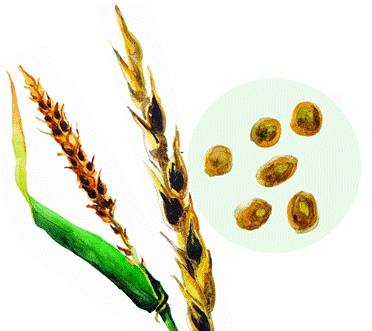
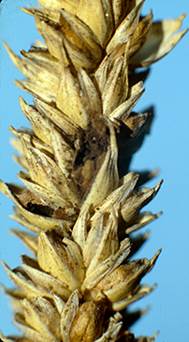
Figure 60 - Common bunt (stinking smut) of wheat
The teliospores of T. levis are light brown, smooth, and ellipsoidal or slightly elongated, measuring approximately 18.5 × 14.5-16.6 micrometers, while those of T. caries are spherical or mildly oval, dark brown, and feature reticulate thickenings that form pentagonal loops. T. levis is more aggressive and can infect virtually all wheat types. Studies have shown that this species differentiates into various physiological races, each adapted to infect specific wheat varieties (Ulyanishchev, 1968).
а) 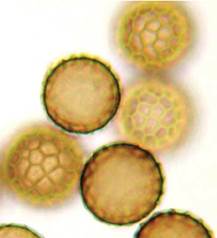 б)
б) 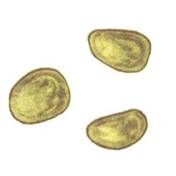
а) Tilletia caries; б) Tilletia levis
Figure 61 - Teliospores of the fungus genus Tilletia
The primary means of infection for common bunt (stinking smut) in wheat is through seeds that become contaminated during the harvest. In the dry conditions of Central Asia, the pathogen is capable of surviving in the soil. When the seeds are planted, the smut spores begin to germinate, forming single-celled basidia, which produce basidiospores at their tips. These spores pair and fuse, generating an infectious hypha that penetrates the wheat's coleoptile. As the fungus develops, it spreads throughout the plant, ultimately reaching the growing point. Instead of producing normal grains, the infected plants form smut bags covered with protective membranes (Shvartsman, 1960).
Distribution and harmfulness. The common bunt (stinking smut) is widespread throughout Central Asia, especially in the southern and southeastern parts of Kazakhstan, where winter wheat is predominantly cultivated, as well as in the eastern regions. In the northern and western areas, it is seldom observed on spring wheat. The extensive use of soil conservation practices aimed at better utilizing rainfall in July has disrupted the long-established interaction between the pathogen and its wheat host by shifting planting schedules to the latter part of May. It is known that the optimal temperature range for T. caries spore germination and their subsequent infection of wheat is between 8 and 13 °C (Ishpaikina et al., 1972). In the northern areas of the republic, the soil temperature at the planting depth during the second and third weeks of May typically reaches 15-20 °C or more, which encourages the quick and even sprouting of seeds, allowing the young plants to avoid pathogen infection.