
4.3 Ergot
The causative agent of the disease is Claviceps purpurea Tul. from the family Clavicipitiaceae. Fungi from this group are known for the production of ergot alkaloids, which are linked to the biosynthesis of amino acids such as histidine and tryptophan (Gzhekhchek, 1976). The disease becomes evident on the ears as horn-like structures or sclerotia, which vary in colour from purple to black and measure approximately 3-4 cm in length, replacing the normal grains (Figure 62).
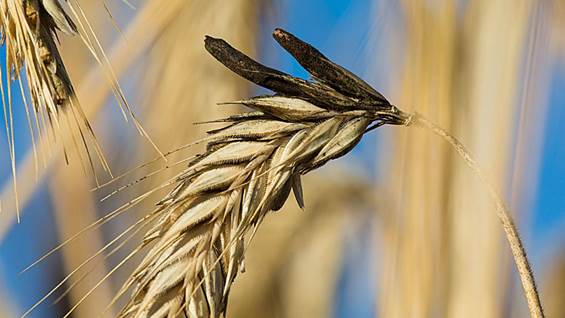
Figure 62 - Wheat ergot
These sclerotia remain on the soil surface or are incorporated into the soil during planting, where they begin to sprout in the spring. They produce reddish stromata that can reach a diameter of 3-4 mm, each containing between 200 and 300 fruiting bodies, or perithecia, filled with asci and ascospores. During the flowering period of cereal crops, these spores are released from the asci and dispersed by the wind. When the spores land on the ears, they germinate and penetrate the ovary through the stigma, leading to the destruction of the developing grain. As the fungus produces abundant conidia, it secretes a sweet, sticky liquid known as honeydew, which attracts insects. This facilitates the rapid spread of the disease, as the fungus's mycelium grows and transforms the ovary into a sclerotium. Observations in Northeast Kazakhstan have shown that ergot is extremely rare. Grain that contains more than 0.5% ergot is not suitable for processing into flour or for use as animal feed due to the presence of highly toxic alkaloids. To remove ergot sclerotia from seeds, methods such as sieving with specialised pneumatic sorting tables are employed, along with immersion techniques that involve using solutions of salts or nitrates with a specific density (Geshele, 1956).